
Teach Me to Pray: Learning to Speak With God Without Fear or Performance
Many people want to pray but feel unsure how to begin.
They worry about saying the wrong words.
They wonder if their prayers are too small, too repetitive, or too honest.
Some feel they should already “know how,” and that uncertainty keeps them silent.
Yet prayer was never meant to be a performance.
When the disciples asked Jesus, “Lord, teach us to pray,” they were not asking for eloquence. They were asking for a relationship. They wanted to know how to speak with God in a way that was real, grounded, and faithful.
That desire has not changed.
Prayer Begins With Permission, Not Perfection
One of the most significant barriers to prayer is the belief that we must arrive prepared.
Prepared with the right words.
Prepared with the correct posture.
Prepared with the right emotional state.
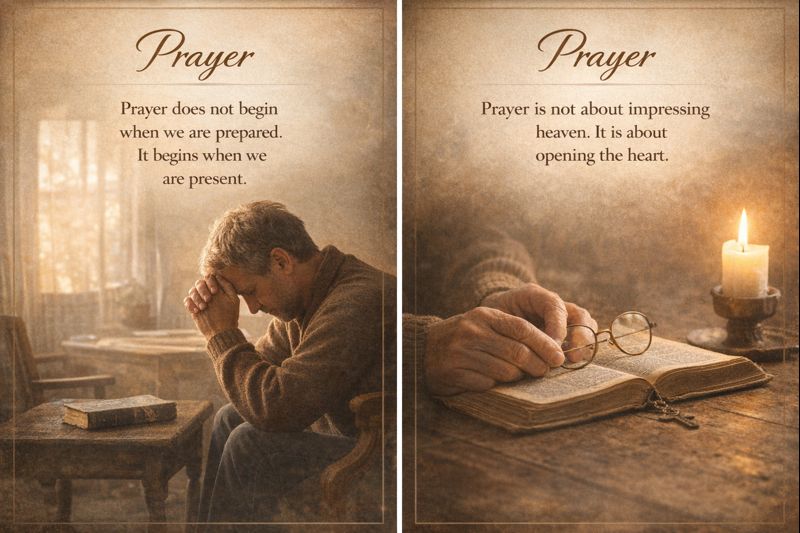
But prayer does not begin when we are polished.
It begins when we are present.
God does not wait for us to sound holy. He invites us to be honest.
Prayer is not about impressing heaven.
It is about opening the heart.
Prayer Is Relationship Before It Is Request
Many people approach prayer as a list of needs.
While God welcomes our requests, prayer is not merely asking—it is communing.
Prayer is:
-
Speaking and listening
-
Bringing the whole self, not just the urgent parts
-
Allowing God to shape us, not only to fix things for us
Before prayer changes circumstances, it changes orientation. It turns us toward God, away from isolation, and back into alignment with what is true.
Simple Prayers Are Often the Deepest
Some of the most potent prayers in Scripture are short.
“Lord, help me.”
“Create in me a clean heart.”
“Your will be done.”
These prayers carry weight because they are sincere.
Prayer does not require length to be meaningful.
It requires attention.
A whispered prayer offered with trust can be more powerful than a long prayer offered from habit.
Prayer Is Learned by Practice, Not Mastery
No one is born knowing how to pray.
Prayer is learned the same way relationships are learned—through time, repetition, and grace.
Some days, prayer feels clear.
Other days, it feels dry or distracted.
Both days still count.
Consistency matters more than eloquence. Returning to prayer, even when it feels imperfect, builds trust and depth over time.
Honest Prayer Makes Room for God’s Work
Many people censor themselves in prayer.
They hide anger.
They soften disappointment.
They avoid questions they feel are inappropriate.
But God already knows the heart.
Prayer becomes transformative when we allow ourselves to be truthful—about fear, doubt, hope, and longing. Honest prayer creates space for healing, wisdom, and peace.
God does not require us to resolve our feelings before bringing them to Him.
Silence Is Also a Form of Prayer
Prayer is not always spoken.
Sometimes prayer is sitting quietly, aware of God’s presence.
Sometimes it is breathing deeply and resting in trust.
Sometimes it is listening rather than speaking.
Silence allows prayer to move from words into awareness.
In silence, we are reminded that prayer is not driven by effort, but by attention.
Prayer Aligns the Heart Over Time
Prayer does not always change situations immediately.
But it consistently changes us.
Through prayer:
-
Fear loosens its grip
-
Perspective widens
-
Urgency softens
-
Discernment grows
Prayer aligns the heart with God’s wisdom and steadiness. Over time, this alignment affects decisions, relationships, and responses to life’s challenges.
Prayer in the Second Half of Life
As life matures, prayer often changes.
It becomes less about control and more about trust.
Less about urgency and more about discernment.
Less about proving faith and more about resting in it.
Prayer becomes a companion rather than a task.
For many, this season brings a more profound, quieter prayer life—one marked by gratitude, reflection, and surrender.
This is no less a prayer.
It is seasoned prayer.
A Simple Invitation
If you are unsure how to pray, begin.
You might say:
“God, I am here.”
“Teach me to listen.”
“Help me trust You with today.”
Prayer does not demand fluency.
It welcomes willingness.
The invitation to pray is always open, and the teacher is patient.
Teach Me to Pray
To ask “Teach me to pray” is not a confession of weakness.
It is a confession of desire.
It is the heart reaching toward God with humility and hope.
Prayer is not about having the right words.
It is about being willing to speak—and to listen.
And that willingness is always enough to begin.

